Vintage Binary: A Display Font That Builds Brand Trust
As a small business owner who’s designed everything from coffee sleeve labels to Instagram story templates, I know how much a single font choice can shape how customers see your brand—not just in style, but in credibility. Vintage Binary isn’t just another retro-looking typeface. It’s a thoughtfully crafted display font that balances nostalgic charm with clean readability—making it one of the most practical vintage fonts I’ve used for real-world branding.
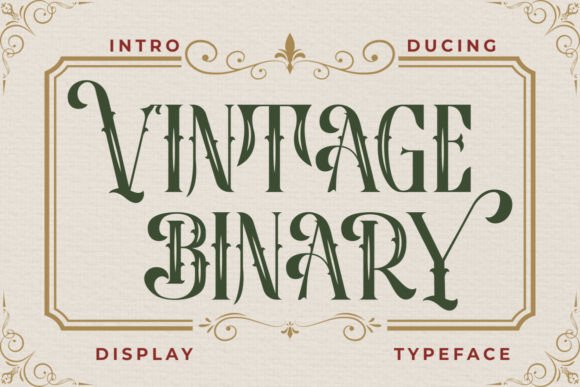
Vintage Binary has that unmistakable mid-century display personality: crisp letterforms, subtle geometric structure, and gentle contrast between thick and thin strokes. It doesn’t scream “vintage”—it whispers it, with confidence. There’s no distressed texture or forced grunge. Instead, it feels intentional, refined, and quietly confident—ideal for businesses that want warmth and character without sacrificing professionalism.
I first used Vintage Binary for a local candlemaker’s product labels. Her soy candles are hand-poured, scented with botanicals, and sold at farmers’ markets and indie boutiques. She needed something that felt artisanal but not overly rustic—something that said “carefully made” rather than “thrown together.” Vintage Binary on her kraft paper labels gave instant cohesion: same font on the front label, back ingredient list header, and thank-you card tucked inside each box. Customers began recognizing her brand before even seeing the logo.
That’s the quiet power of a strong display font: consistency across touchpoints builds recognition. When your café menu, takeout bag stamp, website banner, and Instagram highlight cover all use Vintage Binary for headings—and pair it with a simple sans serif like Inter or Open Sans for body text—you’re not just choosing aesthetics. You’re guiding how people experience your brand rhythmically, repeatedly, reliably.
Vintage Binary works best where attention matters most: logos, signage, packaging headers, social media graphics, email subject lines, and printed flyers. It’s not meant for paragraphs or fine print—but that’s exactly why it shines as a display font. On a boutique’s woven clothing tag? Perfect for the brand name stitched at the top. On a coaching business’s workshop poster? Strong and approachable for the headline “Find Your Focus.” On a handmade soap label? Elegant enough for “Lavender & Oat Milk,” while leaving room for clear usage instructions in a supporting font.
Readability is non-negotiable—especially when your font appears on a 2-inch product sticker or a mobile-optimized Instagram carousel. Vintage Binary holds up well in these settings because its letter spacing is open, its x-height is generous, and its characters avoid excessive ornamentation. I tested it at 14pt on matte-finish product tags—it stayed legible under market tent lighting and phone flash. At 48pt on a website hero banner? It anchored the whole layout without competing with photography.
Before rolling it out everywhere, I recommend testing Vintage Binary in three real contexts: print a mock-up label at actual size, preview an Instagram post on your phone screen, and paste it into your website’s CMS to see how it renders across devices. Small adjustments—like tightening tracking slightly for all-caps headlines or increasing line height when paired with body text—make a noticeable difference in polish.
Font pairing is where Vintage Binary becomes truly versatile. Its personality pairs beautifully with neutral, highly readable companions. Try it with a warm, humanist sans serif (like Poppins or Nunito) for digital and print materials alike. For a more grounded, editorial feel—say, on a wellness brand’s newsletter or product catalog—pair it with a soft serif like Lora or Merriweather. Avoid pairing it with other decorative or script fonts; Vintage Binary carries enough voice on its own. Think of it as your brand’s “first impression” typeface—strong, memorable, and supported by quieter, functional fonts.
Licensing is worth pausing on—especially if you’re selling physical products or offering branded templates. Vintage Binary is a commercial font, meaning you’ll need a license that covers your specific use case: product packaging, client work, digital downloads, or merchandise. Most reputable sellers offer clear licensing tiers. If you’re putting it on candle jars, tea tins, or downloadable Canva templates for customers, double-check that your license permits production use—not just personal or web display. Skipping this step can lead to delays, reprints, or legal friction down the line.
For service-based businesses—like life coaches, bookkeepers, or yoga studios—Vintage Binary adds grounded warmth without leaning too casual. I helped a financial planner revamp her brand assets: her old logo felt cold and generic; swapping in Vintage Binary for her wordmark (paired with a clean monospace for stats and dates) gave her materials immediate distinction. Clients told her she “finally looked like someone they could trust with their goals.” That’s not magic—it’s smart typography aligned with audience expectations.
It’s also surprisingly adaptable across industries. A craft brewery used Vintage Binary for limited-edition can designs—giving their “Heritage Hazy IPA” release a sense of legacy without looking dated. A ceramicist stamped it onto clay coasters as part of her shop logo. A children’s illustrator uses it for book title treatments and workshop banners—its friendly geometry reads as playful but never childish.
The bottom line? Vintage Binary helps small businesses look intentional—not trendy, not generic, but *thought through*. When your packaging, website, and social posts share a common typographic thread, customers subconsciously register your brand as cohesive, capable, and worth returning to. In a crowded marketplace, that kind of quiet consistency is one of the most valuable design assets you can invest in.
If you’re refreshing your brand identity or launching something new, give Vintage Binary a place in your shortlist—not as a novelty, but as a strategic display font that supports your message, strengthens your presence, and grows with your business.